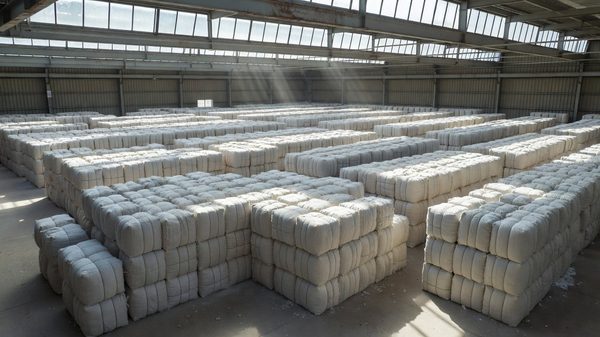
In February 2026, the United States and Bangladesh signed an agreement that quietly rewrote the sourcing calculus for every yarn supplier selling into Dhaka. The headline number — a 19 percent reciprocal tariff on most Bangladeshi goods — obscured a more consequential clause: conditional zero tariffs on Bangladeshi apparel, tied directly to Bangladesh’s purchases of US-produced cotton and man-made fibre.
For Indian spinning mills, which supply a significant share of Bangladesh’s yarn imports, that linkage is not an abstraction. It is a competitive signal that demands a clear-eyed read.
What the Agreement Actually Says
The White House joint statement from 9 February 2026 commits the United States to establish a mechanism under which eligible Bangladeshi textile and apparel goods can enter the US market at a zero reciprocal tariff rate. Critically, qualifying import volumes will be calculated in proportion to Bangladesh’s exports of US-produced textile inputs — meaning the more US cotton Bangladesh buys, the larger the duty-free export quota it unlocks.
The deal also commits Bangladesh to purchases of approximately $3.5 billion in US agricultural products, including wheat, soy, corn, and cotton. For context, Bangladesh’s cotton imports from the US stood at roughly 10 percent of its total cotton basket in 2025, according to the Bangladesh Textile Mills Association (BTMA). BTMA analysts have suggested that share could rise four to five times if the zero-tariff mechanism proves predictable and well-structured.
At the same time, the tariff differential between India and Bangladesh — measured on US market access — has effectively narrowed. Bangladesh’s garment exports to the US now face a headline rate of 19 percent, with a conditional path to zero. India’s exports carry a separate reciprocal tariff structure. Trade press analysis from Business Standard noted in February 2026 that the tariff margin advantage Bangladesh holds over India on the US market has shifted in Bangladesh’s favour, placing pressure on Indian textile exporters.
The Structural Gap That Protects Indian Suppliers — For Now
Bangladesh’s garment sector exports approximately $44 billion annually, with cotton garments making up roughly 80 percent of that volume. That translates to an implied yarn and fabric demand of $17–18 billion. Domestic spinning and weaving capacity can support only $3–4 billion of that demand. In practice, only 20–25 percent of Bangladesh’s yarn and fabric needs can be met internally; the remainder is sourced from India and, to a lesser extent, Vietnam.
That structural gap is the central reason most trade analysts assess the risk to Indian suppliers as real but not catastrophic in the near term. Writing in Asian News Network in early 2026, analysts noted that even with strong incentives to shift to US cotton, Bangladesh cannot physically substitute Indian yarn fast enough to threaten its 40–50 percent EU value-addition requirements post-LDC graduation. The EU’s rules of origin under GSP+ effectively require double transformation — fabric made locally — and that constraint is not resolved by importing more US raw cotton alone.
How the Zero-Tariff Mechanism Reshapes Incentives
The mechanism’s logic operates at the mill level. A Bangladeshi spinning mill that shifts its cotton sourcing from Indian or Brazilian origin to US-grown Upland will generate credits toward the duty-free export quota. That quota, in turn, allows downstream garment exporters — its customers — to ship to the US at zero tariff rather than 19 percent.
The commercial pressure on Bangladesh’s spinners to adopt US cotton therefore flows from their garment-manufacturer customers. Garment exporters will increasingly ask their upstream yarn and fabric suppliers: can you supply US-cotton-traceable input? Mills that cannot will lose orders to those that can.
For Indian yarn suppliers, the first-order effect is a narrowing addressable market in Bangladesh’s spinning sector. Indian cotton, which comprises a significant share of Bangladesh’s blended and single-origin yarn, does not generate zero-tariff credits under the current mechanism. That means Indian raw cotton exports to Bangladesh face the same incentive erosion as Indian yarn, unless the deal’s fine print includes provisions for regional fibre sourcing — details that were still being negotiated as of June 2026.
The Indian Supplier’s Practical Calculus
Indian spinning mills supplying Bangladesh face a differentiated risk profile depending on product segment.
Commodity cotton yarn (Ne 20–30): This is the segment most exposed. Bangladesh’s domestic spinners, if operating at higher capacity with US cotton, will compete directly in this range. Indian exporters here face both the demand-substitution effect and the reduced processing margin available to Bangladeshi mills using zero-tariff inputs.
Compact and speciality yarns: The risk is lower. Bangladesh’s installed spinning base has quality ceilings — BTMA member mills reported operating at roughly 50 percent capacity utilisation in 2025 due to high input costs and erratic energy supply. Speciality constructions, blended counts, and carded compact cotton remain areas where Indian mills hold capability advantages that Bangladeshi spinners cannot quickly replicate.
Fabric and grey cloth: Bangladeshi weavers depend heavily on Indian grey cloth for their value chain. This supply relationship is structurally stickier than yarn sourcing because proximity, lead times, and weave specifications create switching costs. The trade deal does not directly incentivise Bangladesh to replace Indian fabric with US fabric.
What Sourcing Teams Should Watch
Three data points will determine how much damage this deal actually inflicts on Indian yarn exports to Bangladesh over the next two to three years.
First, the volume caps on the zero-tariff mechanism. Until Bangladesh and the US publish the formula for calculating qualifying import volumes, the commercial incentive cannot be fully modelled. A narrow cap rewards only the largest Bangladeshi exporters; a generous cap reshapes the entire market.
Second, BTMA’s response to capacity utilisation. Bangladesh’s domestic spinners are currently operating at roughly half installed capacity. If the zero-tariff mechanism provides enough margin improvement to justify full-capacity operation, domestic yarn output rises regardless of which cotton is used. That output directly competes with Indian imports.
Third, LDC graduation timing. Bangladesh’s LDC status expires in November 2026. Post-graduation, EU buyers will require domestically produced fabrics to meet double-transformation rules of origin. That requirement — more than the US deal — may prove the stronger long-term driver of capacity investment in Bangladeshi spinning and weaving, which would have sustained knock-on effects for all regional yarn suppliers.
The US–Bangladesh deal has shifted the incentive structure, not yet the physical supply flows. Indian yarn suppliers with significant Bangladesh exposure have a window to assess their product mix, customer relationships, and traceability credentials before the mechanism’s full commercial parameters are known.