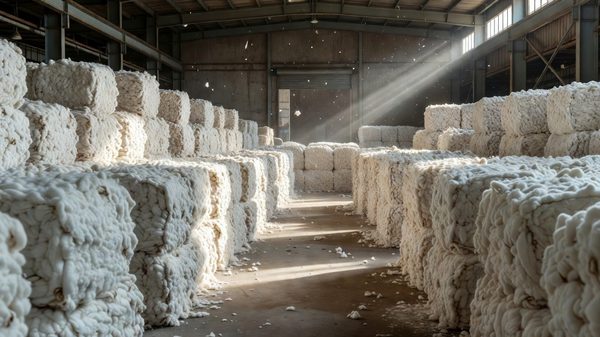
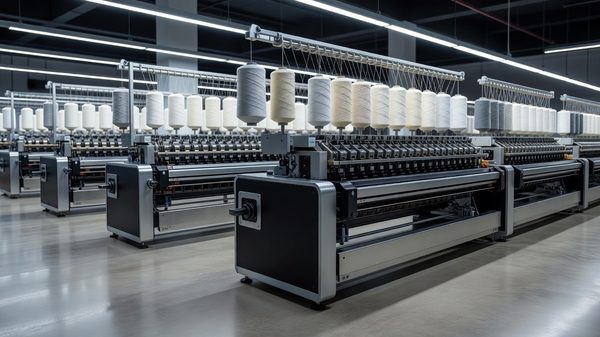
The Cotton Corporation of India ran one of the largest minimum support price operations in its history during cotton season 2025-26, and the consequence most often missed in coverage is not about price. It is about grade. When the state becomes the highest reliable bidder for a crop, the composition of what reaches the open market changes, and spinning mills feel that as a quality problem before they feel it as a cost problem.
The Scale of the 2025-26 Operation
CCI procured more than 52.2 million quintals of seed cotton through nearly 2.4 million farmer transactions during the season, transferring roughly Rs 41,530 crore directly into growers’ bank accounts. Those are figures that describe a market-making participant, not a residual buyer of last resort.
The legal design makes this predictable rather than discretionary. CCI is obliged to purchase at the notified MSP wherever market prices fall below it, without quantity limits. It is not exercising judgment about how much to buy; it is absorbing whatever arrives at its centres while the price condition holds. In a season where open-market prices sat below MSP across much of the cotton belt, that obligation converts into very large volumes.
The Mechanism That Squeezes Quality
The grade effect follows from ordinary grower rationality, and it is worth setting out step by step because it is frequently described as though CCI were deliberately selecting the best cotton.
MSP is notified for Fair Average Quality cotton. A grower whose lot meets FAQ can sell it to CCI at the notified price with assured payment. A grower whose lot falls short of FAQ — higher trash, moisture outside limits, shorter staple, discoloration — cannot, and must sell into the open market at whatever the private trade will pay.
When open-market prices are above MSP, the better lots stay in the trade because the trade pays more for them. When open-market prices fall below MSP, that reverses: the FAQ-and-better cotton goes to CCI because CCI is now the better price, and what remains circulating privately is disproportionately the material that could not clear the FAQ bar. Mills are then buying from a pool whose average quality has been selected downward, at a moment when the headline market price looks soft.
For the 2026-27 season, the notified MSPs are Rs 8,267 per quintal for medium staple and Rs 8,667 for long staple, with extra-long staple Suvin highest at Rs 9,867 per quintal — an increase of about Rs 557 per quintal, or roughly 7 per cent, over the previous season. MSP is fixed at a minimum of 1.5 times the all-India weighted average cost of production, so the floor moves with cultivation costs rather than with mill economics. CCI procurement begins 1 October 2026 wherever market prices fall below those levels. A higher floor raises the probability that the below-MSP condition is met, which raises the probability of a repeat.
Why MSMEs Feel It First
The squeeze is not evenly distributed, and the reason is inventory capacity rather than negotiating skill.
CCI does not retire the cotton it buys; it resells through auctions and tenders. Access to those disposals favours buyers who can bid for large lots, take delivery within tender timelines, arrange the financing, and hold stock. A large integrated mill can participate in CCI disposals and effectively buy back the quality that was diverted. A small or medium spinner buying week to week from local traders often cannot, and is left with the residual open-market pool without the offsetting channel.
The result is a widening quality gap between segments of the same industry buying in the same season. It shows up in the mill as higher blowroom and carding waste, more frequent count changes to accommodate available staple, increased ends-down and yarn faults, and customer complaints on evenness — all of which are cost, but none of which appear on the lint invoice.
The Compounding Factors in 2025-26
The procurement effect did not operate in isolation. Domestic production, demand and closing stocks all declined during the season, exports were weak, and mill offtake was subdued. The Cotton Association of India’s revised figures put pressings at 337 lakh bales of 170 kg against consumption of 348 lakh bales, with imports raised to 60 lakh bales — a structural deficit that CCI’s holdings sat on top of.
Import policy has partially offset it. The duty exemption on cotton imports running from 1 June to 31 October 2026 gave mills access to overseas staple without the roughly 11 per cent duty burden, which for a mill needing a specific staple length is often the more direct fix than competing for domestic lots. That window closes on 31 October, immediately after CCI’s new-season procurement begins on 1 October — a two-way pressure at exactly the moment the new crop arrives.
What a Mill Can Actually Do
Little of this is within a spinner’s control, which makes the controllable parts worth naming precisely.
Track the MSP-to-market spread rather than the market price alone. The spread, not the level, predicts whether the quality pool is about to deteriorate. A market drifting below MSP is the leading indicator.
Build CCI disposal participation into procurement planning where scale permits, including the financing and storage that tenders require. Mills that treat auctions as an occasional opportunity rather than a standing channel tend to be absent in the seasons when it matters most.
Cost the quality consequence explicitly. A mill that books lint at an attractive price and absorbs the extra waste in overheads will conclude it bought well. Waste percentage, count-change downtime and yarn-fault rates measured against grade are what reveal whether a cheap bale was cheap.
Contract forward on grade specification, not price alone. Where the pool’s average quality is being selected downward by policy, a contract that fixes only price transfers the grade risk to the buyer.
Sources: Cotton Corporation of India procurement data for cotton season 2025-26; Commission for Agricultural Costs and Prices MSP notifications for cotton season 2026-27; Cotton Association of India revised 2025-26 balance sheet; Notification No. 19/2026-Customs on cotton import duty exemption.